The Morgan story · Appendix
Dating a Morgan
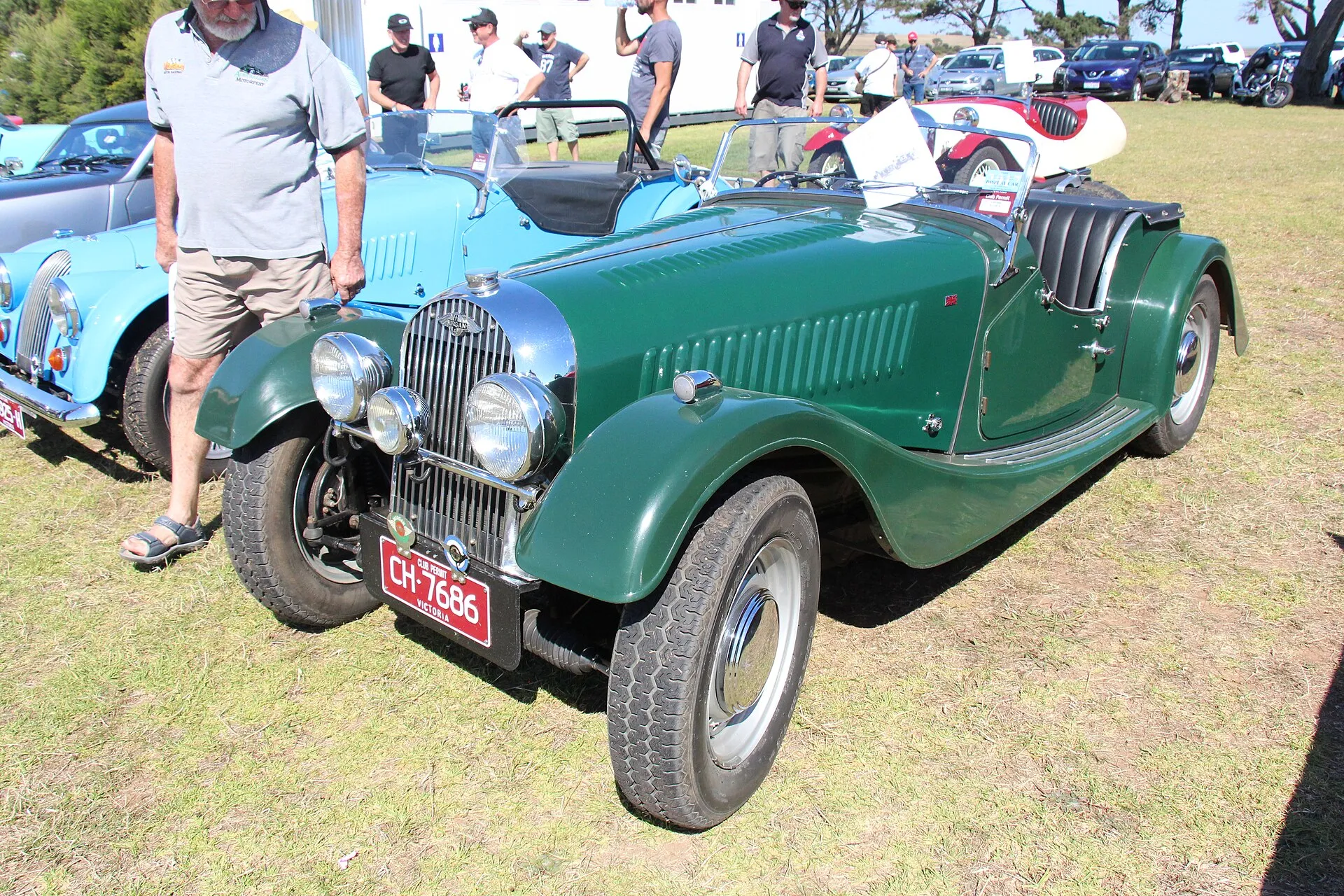
Morgans changed in small steps. These are the steps that date a car.
If you have ever wondered just how old your Morgan is, start here! Owners use this to place a car in its year. It comes from Mark Braunstein’s model chart, and it is part of the Morgan story.
For owners
How to date a Morgan
The production changes that help place a car, in date order, from Mark Braunstein’s chart. The factory phased new parts in gradually, so a car can sit either side of a change.
-
c. 1924
First Stork mascot seen
Date on the chart
-
c. 1934
Three-wheeler V-twins change from J.A.P. to Matchless
Year read from the chart
-
c. 1951
Plus 4 and 4/4 rear axle changes from Moss to Salisbury
Year read from the chart
-
c. 1953–1954
Plus 4 interim radiator (the “high cowl”)
Year read from the chart
-
c. 1955
Plus 4 chassis changes from trunnion to shackle: the rear springs sit inside a tube, then in shackles
Year read from the chart
-
c. 1959
Plus 4 bonnet knobs change from bullseye to smooth
Year read from the chart
-
c. 1960
Plus 4 disc brakes, from chassis 4671
Year read from the chart
-
1962–1963
Magnolia gauges change to black
Date on the chart
-
c. 1962
Plus 4 toggle switches
Year read from the chart
-
c. 1962–1963
Sidescreens change from one piece to sliding; the drophead coupé gets a curved windscreen
Year read from the chart
-
1965
Seat belts
Date on the chart
-
c. 1967
Generator changes to an alternator (the chart’s estimate)
Date on the chart
-
c. 1972
Switch to a dual brake master cylinder
Year read from the chart
-
c. 1972
Smiths heater changes from a circular to a box core
Year read from the chart
-
c. 1976
Plus 8 body made 4 inches wider
Year read from the chart
-
c. 1978–1995
Cars for the US run on propane. Sources differ: the Isis history has the conversions from 1974 to 1992 (Chapter V)
Year read from the chart
-
c. 1981
Coloured wing beading available
Year read from the chart
-
c. 1982
Plus 8 rack-and-pinion steering
Year read from the chart
-
1986 on
Wood preservative on all cars
Date on the chart
-
No date given
Salisbury rear axle, then the BTR axle
No date on the chart — between 1986 and 1997
-
c. 1990–1992
4/4 narrow body changes to the wide Plus 8 body (4 inches wider); servo-assisted brakes standard
Year read from the chart
-
1997 on
Superform on all cars (the chart’s term)
Date on the chart
-
1998 on
Long door and electric demisters on all cars
Date on the chart
-
No date given
Chassis numbers change from 5 to 17 digits (VIN)
No date on the chart — between 1998 and 2000
-
2000 on
Galvanised chassis on all cars
Date on the chart
-
No date given
Plastic radiators
No date on the chart — between 2000 and 2008
-
No date given
Steering bearings replace damper blades
No date on the chart — between 2000 and 2008
-
c. 2006
Easy-up hood on the Plus 4
Year read from the chart
-
2008–2009
New winged logo
Date on the chart
-
No date given
Spare wheel optional; parcel-shelf pass-through available
No date on the chart — around 2010
-
Late 2011
Mazda MX-5 gearbox standard on the Plus 4
Date on the chart
-
2012 on
Mazda MX-5 gearbox on all cars except the Roadster
Date on the chart
-
c. 2016
The galvanised chassis ends; chassis are painted instead
Year read from the chart
-
April 2018
Roadster Series 4 rear suspension changes from leaf springs to a five-link coil-sprung rear
Date on the chart
-
c. 2020
The ladder frame with sliding-pillar front suspension ends
Year read from the chart
-
9 November 2022
Plus Four and Plus Six rebranded for the 2023 model year
Date on the chart
-
Model year 2023
Electronic stability control on the Plus Four
Date on the chart
Plus 4 engine numbers
Read the prefix
- V
- Standard Vanguard
- TS
- Triumph TR2 and TR3
- CT
- Triumph TR4
Every TR2–TR4 engine fitted to a Morgan ends in ME.
From Braunstein chart, v139.
Plus 4 speedometers
- 1950–1958
- 110 mph, cream, with a clock
- 1959–1960
- 110 mph, cream, without a clock
- 1961–1962
- 120 mph, cream, with toggles
- c. 1963–1964
- 120 mph, black
- c. 1965–1969
- 140 mph, black
Chassis numbers that mark a change
- 4671
- Plus 4: disc brakes from here
- R7475
- Plus 8: Rover four-speed gearbox from here
- R7494
- Plus 8: the last Moss gearbox
- R8151
- Plus 8: Rover five-speed gearbox from here
- 606
- Plus 4 two-seaters with the flat radiator, as the chart counts them
- 117
- Plus 4 drophead coupés with the flat radiator
- 433
- Plus 4 drophead coupés with the cowled radiator
From Braunstein chart, v139.
Words owners use
A short glossary
The terms that turn up when people talk about a Morgan’s age and parts, in plain English.
- Sliding pillar
- The front suspension HFS Morgan designed for his first car. Each front wheel rides on a stub axle that slides up and down a fixed vertical pillar, against a coil spring. He patented it in 1910, and the idea itself is older. Morgan stopped using it in 2020. Wikipedia, Patent GB 20,986, Braunstein chart, v139 The end of the sliding pillar.
- Ash frame
- The wooden frame under a Morgan’s body. Morgan says ash is the only wood it uses for frames, designed on a computer today and still made by hand, with aluminium panels over it. The 4-4 of 1936 had an ash frame panelled in steel. Morgan, 21st Century Coachbuilding, Morgan, History (2022)
- Flat, interim and cowled radiators
- The three front ends of the early Plus 4. Until late 1953 the radiator stood upright and flat, as on every four-wheeled Morgan. A short run of cars, about nineteen, had an interim cowl that curved back only at the top. From 1954 the cowl curved at the top and the sides. Wikipedia, gomog.com Flat, interim, cowled.
- Moss gearbox
- A four-speed gearbox made by Moss. The Plus 4 had one from its launch in 1950, and the first Plus 8s had one too; Morgan gives the Plus 8’s four-speed as 1968 to 1977. Wikipedia, Unsigned company history, Morgan, Plus 8 page The V8 years.
- 4-4 and 4/4
- The name means four cylinders and four wheels, chosen in 1936 to tell the car from the three-wheeler. The Series I ran from 1936; the Series II of 1955 brought a Ford engine, and later series followed with new Ford engines: III in 1960, IV in 1961 and V around 1963. Morgan, History (2022), Wikipedia, Braunstein chart, v139 The fourth wheel.
- V-twin and F-type
- The two kinds of vintage three-wheeler. The V-twins, from 1910, had a tubular steel chassis and a J.A.P. V-twin engine at the front. The F-type, from about 1933, had a Ford four-cylinder engine in a conventional bonnet, on a steel ladder-frame chassis. Morgan, History (2022), Wikipedia Three speeds, and a Ford.
- Runabout, Grand Prix, Aero, Super Sports
- Names from the three-wheeler years that came back. Runabout was the first production model. The Grand Prix was named after the 1913 race at Amiens. The Aero, from 1920, was named for aviators and inspired by Albert Ball’s car. The Super Sports name returned for the Aero SuperSports of 2009. Morgan, History (2022), Unsigned company history Amiens.
- Trunnion and shackle chassis
- Two ways of fixing the rear springs. On a trunnion chassis the springs are secured inside a tube that runs between the chassis rails; on a shackle chassis they are held in shackles. Braunstein’s chart marks the Plus 4 changing from trunnion to shackle about 1955. Braunstein chart, v139 Flat, interim, cowled.
- Beetleback, barrelback and the Flying M
- Two shapes of vintage three-wheeler tail. On Braunstein’s chart the beetleback gives way to the barrelback about 1934, and the “Flying M” radiator mascot arrives with the barrelbacks; the Stork, first seen about 1924, had been used before it. Braunstein chart, v139 Three speeds, and a Ford.
- Bustle back
- A Plus 4 body style named on Braunstein’s chart, running from about 1954 to 1958. The chart ends its line at chassis 4023 and does not describe the shape. Braunstein chart, v139
- Standard Special
- The 4/4 of 1939 and after with Standard’s 1,267 cc engine in place of the Coventry Climax. Braunstein’s chart counts between 539 and 700 Standard Special engines produced. Braunstein chart, v139, Wikipedia Sir John Black’s engine.
- Superform
- The chart’s word for a way of shaping the aluminium body panels, which it marks on all cars from 1997. Braunstein chart, v139
- Flapper, Hotwire and GEMS
- The names the chart gives to stages of the Plus 8’s Rover V8. The “Flapper” is the SD1 3.5-litre with fuel injection, about 204 bhp, from about 1984; the “Hotwire” is the 3.9-litre (about 190 bhp) and then the 4.6-litre (about 215 bhp); and GEMS is a 4.0-litre of about 190 bhp. Braunstein chart, v139 The V8 years.
- CX, CXV and CX-T
- CX is the bonded-aluminium platform that arrived with the Plus Six in 2019 and carries the Plus Four from 2020. The Supersport of 2025 is on a developed platform, the CXV. The CX-T is the off-road Plus Four of July 2021, which the chart says was limited. Wikipedia, Braunstein chart, v139 Today.
Sources
Where this comes from
Where every fact on this page that is not from the Registry itself comes from.
Show all 14 sources
-
Braunstein chart, v139
Not an official Morgan Motor Company publication; its author notes it may contain errors, and that new technology reached some cars of a model year before others. Where the chart gives no date, the year shown here is read from the item’s position on the chart and marked “c.”.
-
Wikipedia
Wikipedia, “Sliding pillar suspension” (text CC BY-SA 4.0; facts cited, not reproduced). Checked 4 October 2026.
-
Patent GB 20,986
H. F. S. Morgan, “Improvements in the Design and Construction of Tri-cars or other Light Automobile Vehicles”, British patent 20,986 (applied 8 September 1910, accepted 17 August 1911), via Google Patents. Checked 4 October 2026.
-
Morgan, 21st Century Coachbuilding
Morgan Motor Company, “21st Century Coachbuilding”, morgan-motor.com (read 4 October 2026). Checked 4 October 2026.
-
Morgan, History (2022)
Morgan Motor Company, “Morgan History”, morgan-motor.com/history/, as archived by the Internet Archive’s Wayback Machine on 22 May 2022. Checked 4 October 2026.
The company’s own account. The live page no longer exists, and the archived copy shows only the opening of each paragraph.
-
Wikipedia
Wikipedia, “Morgan +4” (text CC BY-SA 4.0; facts cited, not reproduced). Checked 23 September 2026.
-
gomog.com
Blair, “Morgan four-wheeled cars 1936–1995”, gomog.com. Checked 4 October 2026.
An enthusiast’s page. Its production figures differ from Wikipedia’s in places.
-
Unsigned company history
“Morgan Motor Company History”, an unsigned history in the company’s voice (about 2006), copied as a PDF by a Norwegian Morgan club. Checked 4 October 2026.
Origin unconfirmed. It reads as Morgan’s own website history, but the original page has not been found. It has errors (it puts the 1939 Le Mans car first in class, when the results say second), so nothing here rests on it alone where it matters.
-
Wikipedia
Wikipedia, “Morgan Plus 8” (text CC BY-SA 4.0; facts cited, not reproduced). Checked 4 October 2026.
-
Morgan, Plus 8 page
Morgan Motor Company, “Plus 8”, past models, morgan-motor.com (read 4 October 2026). Checked 4 October 2026.
Morgan’s own summary page: it lists the versions as “76-04” and “12-19” and a four-speed gearbox for “1968–77”, with no day or month.
-
Wikipedia
Wikipedia, “Morgan 4/4” (text CC BY-SA 4.0; facts cited, not reproduced). Checked 4 October 2026.
-
Wikipedia
Wikipedia, “Morgan 3-Wheeler” (text CC BY-SA 4.0; facts cited, not reproduced). Checked 4 October 2026.
-
Wikipedia
Wikipedia, “Morgan Plus Six” (text CC BY-SA 4.0; facts cited, not reproduced). Checked 4 October 2026.
-
Wikipedia
Wikipedia, “Morgan Supersport” (text CC BY-SA 4.0; facts cited, not reproduced). Checked 4 October 2026.